" – Peu importe d’où l’on vient. Il n’y a pas de tonique. Le thème et son développement ne sont qu’un mirage…
Il y a une musique toujours inattendue.
– Et les dissonances ?
– Dieu les a créées, elles aussi…"
Jaume Cabré - "Voyage d'hiver" - 2014

”La terre, il se pourrait bien après tout que ce soit une espèce
de merveilleux petit appareil enregistreur, plaçé là par on ne sait qui,
pour capter tous les bruits qui circulent mystérieusement dans l’Univers.”
Pierre Reverdy - ”En vrac” - 1929

”J’entends tous les bruits de la terre grâce à mes oreilles et mes nerfs de cristal
dans lesquels circulent le feu du ciel et celui des volcans.”
Michel Leiris - ”Le point cardinal” - 1927

"L'écoute, c'est l'ombre de la composition"
Pascal Dusapin - 2008


Affichage des articles dont le libellé est impro. Afficher tous les articles

10/04/2026

Wendy Eisenberg

pic by Ellery Berenger
 

Based in NYC, Wendy Eisenberg has spent the past decade as a fixture of independent music and an artist of inspired multiplicity with art-rock, jazz, free improv and eloquent folk. As a virtuoso guitarist, singer-songwriter and improviser, she uses to explore multiple approaches to diferent genres and techniques. She could interpret experimental pieces from Morton Feldman and Christian Wolff as well make reference to Derek Bailey, Arto Lindsay,  João Gilberto and John Zorn... an ecclectic repertoire.

“I was coming from an Arto Lindsay place and also a João Gilberto and Juana Molina world, where the songcraft is super important but there’s also humor and exploration...  I spent a large part of my life really interested in guitar guitar stuff, like Brouwer, Ted Dunbar’s work, Ted Greene’s work … really just studying from these masters...   Exploring the guitar now is a little more intuitive and has to do with being receptive to how long a decay is, for example. Sometimes I’ll just pick up a guitar and play an open A string and see how long it takes for it to die down and see if it catches one of the reflections of one of the walls in my room, and play to the space." 


Wendy Eisenberg in duo with Shane Parrish (both of them are parts of the amazing Bill Orcutt Guitar Quartet) in this "Nervous systems" opus


& with David Grubbs, founder of the band Gastr del Sol, and Kramer for the trio Squanderers (Wendy's guitar on the right side and David's one on the left side): "Skantiago"


and a fluid solo guitar improvisation 


& as folk songwriter, her last album 

Here a long interview for Premierguitar. 

And don't miss a long review in the april 2026 issue of The Wire


”{_<>_}" 

01/04/2026

L'Espiral


A work by the catalan musician Pedro Vian published on Spire bandcamp site with organ improvisations recorded in the Catalan Pyrenees. 

"A couple of years ago, I stayed in an old house in the Catalan Pyrenees, in the small village of Arsèguel, near the French border. The house was surrounded by nature and faced a vast mountain landscape. In the living room, beside the fireplace, there was an old organ.
I had originally brought my microphone and laptop to record the surrounding soundscapes, but the organ quickly captured my attention. I placed the microphone close to the organ pipes and sat down to improvise, letting the instrument and the atmosphere of the place guide the music. 
The result is a collection of improvised pieces gathered under the title Impressions d’une maison et d’un orgue face à la majesté d’une montagne, impressions of a house and an organ facing the majesty of a mountain."  Pedro Vian


__ >> -0- << __ 

01/11/2025

Minimal music


"Tehran Dust" est une oeuvre de Klaus Lang paru en 2022 chez "Another timbre". Trois œuvres de chambre avec deux arrangements de pièces de musique ancienne de Johannes Ockeghem et Pierre de la Rue. Interprétées par le Trio Amos : Sylvie Lacroix (flûte), Krassimir Sterev (accordéon), Michael Moser (violoncelle), et Klaus Lang (orgue). 
 
"Il y a quelques jours, j'ai entendu une pièce improvisée utilisant des instruments et des motifs traditionnels de la musique iranienne, mêlés à des éléments de musiques non iraniennes. Un genre musical très en vogue, appelé « musique du monde », est composé de courtes unités musicales utilisant toutes le même modèle formel traditionnel et assemblées pour former une suite potentiellement infinie." 
Klaus Lang 2011 
 
** 
"Tehran Dust" is an 2022's opus by Klaus Lang  published on "Another timbre". Three chamber works with arrangements of early music pieces by Johannes Ockeghem and Pierre de la Rue. Performed by Trio Amos : Sylvie Lacroix, flute - Krassimir Sterev, accordion - Michael Moser, cello and with Klaus Lang, organ.
 
"A couple of days ago I heard an improvised piece of music using traditional instruments and patterns taken from traditional iranian music mixed together with some elements of other types of non iranian music. A very fashionable type of music called „world music“. Short musical units that all use the same traditional formal model were stitched together to form a potentiall endless sucession."  
Klaus Lang 2011 
 
 
____________________________________


"Motor tapes"  est un album de 2024 de Sarah Hennies (née en 1979), compositrice et percussionniste américaine basée à New York. Elle est connue pour son travail de compositrice pour ensembles acoustiques. Elle contribue également à l'improvisation, au cinéma et à la performance. Elle s'intéresse à diverses questions musicales, sociopolitiques et psychologiques, notamment les identités queer et trans, la psychoacoustique et les conditions sociales et neurologiques qui sous-tendent la pensée créative. 
 
"La pièce "Clock Dies"  a été la première où je me suis dit : “Voyons si je peux faire de la musique de chambre.” Clock Dies est donc une composition intégrale ; bien sûr, il y a beaucoup de répétitions, une forme avec des sections et des climax, des événements qui se produisent."   Sarah Hennies 2024
  
** 
 
 "Motor tapes" is a 2024's album by Sarah Hennies (b. 1979), an american composer and percussionist based in NYC. She is known for her work as an acoustic group composer. She also contributes to improvisation, film, and performance art. She is concerned with a variety of musical, sociopolitical, and psychological issues including queer & trans-identity, psychoacoustics, and the social and neurological conditions underlying creative thought.
 
"The piece "Clock Dies" was the first piece I made where I thought, “Let’s see if I can make chamber music.” So Clock Dies is through-composed; of course there’s lots of repetition, there’s a form with sections and climaxes—things happen."  
Sarah Hennies 2024  


____________________________________
 
 
"Blanca", un cycle de huit compositions pour alto solo composé par Julia Eckhardt, inspiré par des promenades dans la campagne espagnole. 
 
"En novembre 2022, j'ai passé un mois en résidence d'artiste à Centro Negra, dans la petite ville de Blanca, au sud-est de l'Espagne. J'ai suivi un protocole quotidien de promenade sans but précis, qui m'a conduite dans les vastes collines majestueuses et légèrement intimidantes qui entourent la ville. Chaque jour, après un temps déterminé, je m'arrêtais pour réaliser un enregistrement de terrain et une photo de détail. À mon retour à Centro Negra, j'enregistrais une improvisation à l'alto, faisant écho à l'énergie de ces lieux accidentels." Julia Eckhardt  
  
** 
 
"Blanca", a cycle of 8 compositions for solo viola  composed by Julia Eckhardt, inspired by walks in rural Spain. 
 
"In November 2022, I spent a month as an artist in residency at Centro Negra in the small town of Blanca in the South-East of Spain. I undertook a daily protocol of walking without plan or destination which took me into the wide, majestic, and slightly intimidating hills outside the town. Each day, after a set amount of time I stopped to make a field recording and a detail photo, and upon my return to Centro Negra, recorded an improvisation on the viola echoing the energy of that accidental place." Julia Eckhardt

extraits de l'album "Blanca"
 
 
_-_-_-_-=-_-_-_-_ 


15/08/2025

Paul Metzger


Toujours un intense plaisir d'écouter Paul Metzger et son banjo préparé.

***

extrait d'une interview réalisée par Philippe Delvosalle en 2013

Tes premiers enregistrements mentionnent un banjo à 21 cordes ; les derniers un banjo à 23 cordes… Cela veut dire que l’instrument continue à évoluer ? Et aussi,  j’imagine, que l’instrument n’a pas « sauté » en un seul bond de 4 ou 5 cordes à 21 ? Y a-t-il eu plusieurs banjos, plusieurs prototypes le long de la ligne du temps de ce processus de transformation ? Y a-t-il aussi eu des voies sans issues ? Des moments où tu devais reculer un peu pour redémarrer dans une autre direction ?

Le banjo que je joue actuellement est mon troisième. À chaque fois, je prends des idées des banjos précédents et les applique au nouveau, tout en cherchant à améliorer au passage toute une série de petits détails. Mon premier banjo avait en bout de course 11 cordes : 4 cordes principales et 7 cordes sympathiques. Puis, j’ai au l’idée de rajouter des cordes le long du corps du banjo mais perdu pas mal de temps à trouver un moyen de le faire. Une idée était d’utiliser des chevilles récupérées d’une vieille cithare – mais celles-ci se sont révélées si difficile à accorder ! C’était donc une voie sans issue… Mais, en même temps, c’est tellement agréable de se retrouver là: de faire ce boulot, d’imaginer des solutions, de les tester, d’entendre de nouveaux sons et de découvrir de nouvelles façons de jouer… « Voie sans issue » est peut-être une expression un peu rude…

l'interview compète

live in Tempere - 2010


Excerpt from an interview conducted by Philippe Delvosalle in 2013 
 
Your first recordings mentioned a 21-string banjo; your latest ones a 23-string banjo… Does this mean that the instrument continues to evolve? And also, I imagine, that the instrument hasn't "jumped" in a single step from 4 or 5 strings to 21? Were there several banjos, several prototypes along the timeline of this transformation process? Were there also paths without challenges? Times when you had to back off a bit to start again in a different direction? 
 
The banjo I'm playing now is my third. Each time, I take the ideas from the previous banjos and apply them to the new one, while seeking to improve a whole series of small details along the way. My first banjo ultimately had 11 strings: 4 main strings and 7 sympathetic strings. Then I had the idea of adding strings along the body of the banjo but wasted a lot of time figuring out how to do it. One idea was to use pegs salvaged from an old zither – but these proved so difficult to tune! So it was a dead end… But, at the same time, it’s so nice to be there: doing this work, imagining solutions, testing them, hearing new sounds and discovering new ways of playing… “Dead end” is perhaps a bit of a crude expression…


et un film sur ses singuliers instruments qu'il fabrique... Étonnant!

and a movie about the unique instruments he builds... Amazing! 


<<______I______>>

19/06/2025

Vincent Peirani


Vincent Peirani est un formidable accordéoniste français qui se consacre au jazz, mais pas seulement, récompensé trois fois aux Victoires de la Musique en 2014, 2015 et 2019. Ses champs d'intérêt sont variés: musique classique, musiques du monde, chanson française, jazz... Il participe à des projets divers comme Les égarés, (avec nos amis Vincent Segal, Ballaké Sissoko et Emile Parisien), aussi Bach project avec François Salque au violoncelle pour un répertoire articulé autour du tango, le trio Jokers avec guitare et batterie... 

Vincent Peirani is an amazing French accordionist who devotes himself to jazz, but not only, and who rewarded three times at the Victoires de la Musique in 2014, 2015 and 2019. His fields of interest are eclectic: classical music, world music, French song... He participates in various projects such as Les égarés, (with our friends Vincent Segal, Ballaké Sissoko and Emile Parisien), also Bach project with François Salque on cello for a repertoire based around tango, the trio Jokers with guitar and drums. among others combinations with excellent musicians..


ENJOY!

une superbe improvisation


 ***

& le quatuor Les Égarés


> ...¿•\±... +_

04/04/2025

Decomposition BWV 1017


Semi-improvised performance of Ed Williams' Decomposition of the Siciliana from J S Bach's Sonata IV - BWV 1017. With Anouck Genthon (violin) & Ed Williams (harpsichord) during the Attacca festival, Hochschule für Musik Basel, Ackermannshof, in June 2023. 

The original duet’s part of the Largo has been discarded and the continuo part allowed to flourish to become a different kind of duet, involving the original instrumental pair of harpsichord and violin. Acting like enzymes breaking down organic matter, the two performers collaboratively weave an improvised tissue of timbres, intervals and silences that emerge from the diffraction, repetition and savoring of the original score’s notes. This calls to mind the image of string figures described by Isabelle Stengers: “...but knowing that what you take has been held out entails a particular thinking “in-between”... with the demand that you not proceed with ‘mechanical confidence’... two pairs of hands are needed, and in each successive step, one is ‘passive’, offering the result of its previous operation, a string entanglement, for the other to operate...” (Stengers, 2011).  

 - - -

La partie du duo original du Largo est abandonnée et la partie de continuo peut s’épanouir pour devenir un autre type de duo en soi, impliquant le duo instrumental original du clavecin et du violon. Agissant comme des enzymes décomposant la matière organique, les deux interprètes tissent en collaboration un canevas improvisé de timbres, d’intervalles et de silences qui émergent de la diffraction, de la répétition et de la dégustation des notes de la partition originale. Cela rappelle l’image des figures de cordes décrites par Isabelle Stengers : " ... mais savoir que ce que vous prenez a été tendu implique une réflexion particulière « entre »... avec l’exigence de ne pas procéder avec une « confiance mécanique »... deux paires de mains sont nécessaires, et à chaque étape successive, l’une est « passive », offrant le résultat de son opération précédente, un enchevêtrement de cordes, pour que l’autre opère... " (Stengers, 2011). 


On "Beyond the Coda", another work of Ed Williams: "decomposition study" with an organ,

and another decomposition: "Soave Dolc'Ardore" for a string quartet

<I_I>

15/11/2024

Feuilles et paratonnerre

”Feuilles” a (…) les coudées franches, et Joris Rühl s’est entouré de timbres qui font corps et suivent une ligne claire et ondoyante ; la seconde clarinette de Xavier Charles grossit le trait, suggère l’ombre, donne de l’épaisseur. L’accordéon de Jonas Kocher … apporte un relief qu’un autre va mettre en mouvement... Cet autre, c’est Toma Gouband et ses cailloux chantants. La pierraille qui se cogne comme un cristal au milieu des cymbales et des cloches donne à ”Feuilles” une tout autre dimension dans le premier tiers d’un morceau-titre unique, et l’accordéon s’échappe du simple trait.” - Franpi Barriaux  pour Citizen Jazz

 Après une partie très aérienne et légère, en forme de méditation et de rêve, autour de 22 minutes commence pour quelques minutes, comme un changement de chapitre, une polyrythmie évoquant celles des Pygmés Baka que Toma Gouband a visité et dont il a  étudié la musique en tant que chercheur (dans des domaines de mathématique?). Souvenons nous de la ”Cartographie de rythmes” dont il était un des protagonistes, projet déjà évoqué dans ce blog.
Pour la troisième partie de cette longue pièce, une métamorphose dans un brume abstraite qui va se désintégrer jusqu’à ce que chacun des sons exprimés se dissolvent en silence: éloge de la lenteur.
Publié en septembre 2023 sur l'excellent label Umlaut 

HAUTEMENT RECOMMANDABLE !
”Pour une expérience sensitive de haute qualité” - Jean-Michel Van Schouwburg 


***

Toujours sur le label Umlaut, parue en avril 2024, Griffure, étonnant duo composé de
Léonore Grollemund : cello, voice, composition
& Amaryllis Billet : violin, voice, composition 

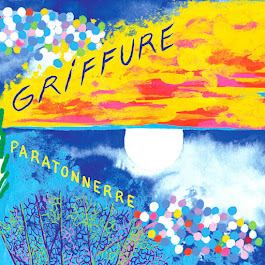
Pour ce "Paratonnerre" , publié en 2024, une déambulation entre improvisation, composition et texte, elles sont ici en quintet à cordes avec 3 autres complices, tandis qu'un  sixième musicien triture les matières au travers d'un dispositif électroacoustique. Des chansons sérieuses ou dadaïstes, sombres ou drôles, surgissent, défiant toute catégorisation possible. Un inouï maelstrom.

“To polyphonic humming, murmuring, jubilant vocalization as magical seductresses in exotica realms, with raspy persuasiveness if necessary. Chouette !” Rigobert Dittman

et une chronique chez Drame de Birgé 


<>!<> 

18/09/2024

Tapage Club memories

 
TAPAGE CLUB memories
(1990 - 2005)
 
15 ans d’activités du studio Tapage Club (Belleville à Paris) entre 1990 et 2005 avec de nombreux enregistrements pour répondre à des commandes de chorégraphes et de documentaristes, à des projets personnels ou par pur plaisir et cordialité. 
Nous avons choisi ici, pour une durée de 3 heures, de présenter volontairement quelques unes de ces nombreuses et diverses musiques de façon désordonnée pour leur qualités d’inspiration et de jeu et pour mieux faire valoir l’éclectisme de ce qui nous a toujours passionné et motivé au sein de Tapage Atypique. 
Dans les années 90, certaines de ces musiques ont été enregistrées et mixées en ”analogique” sur un magnétophone Tascam 8 pistes, ou bien enregistrées live en improvisation avec un simple couple de micros, et depuis l’an 2000 d’autres construites et composées au travers des outils numériques.


This selection of 15 years of sound and musical activities of the Tapage Club studio (in the Belleville neighborhood of Paris) were recorded between 1990 and 2005, among numerous other recordings in response to commissions from choreographers and documentary filmmakers, for personal projects, or simply out of fun and friendship. 
We chose a duration of 3 hours to represent a selection of those numerous and diverse recordings, and present them in a disorderly to better accord with their quality, inspiration, and musicality, but also to better highlight the eclecticism of what has always fascinated and motivated us within Tapage Atypique.
 In the 90s, some of these recordings were taped and mixed “analog,” on a Tascam 8-track tape recorder, or recorded as live improvisations using a simple pair of microphones. Beginning in 2000, other recordings were made and composed using digital tools.


”Tapage Atypique était un laboratoire sonore nouveau alors que je finissais mes études passionnantes mais sérieuses au conservatoire supérieur … une sorte d’Oulipo sonore, avec une liberté créatrice qui sortait de cet écrin précieux, le Tapage Club.”  Vincent Segal
 
“Tapage Atypique was a new sound laboratory while I was finishing my exciting but serious studies at the conservatoire supérieur… a kind of Sound Oulipo, with a creative freedom that emerged from this precious setting, the Tapage Club.” Vincent Segal


Remerciements à Claire Piguet pour l’architecture de ce studio, Georges Errera et Elein Fleiss pour la production de certains disques, Anaïs Prosaïc, Francis Falceto, David et Lionel Ruffel (Chaoïd) pour leurs diverses implications et pour le suivi de nos productions ”Tapage Atypique” et ”Song Active Production” pendant ces années. Merci également à tous les artistes et amis qui nous ont fait confiance et ont activé avec générosité certaines des productions réalisées au Tapage Club: Derek Woodgate, Yolande Snaith, Brigitte Farges, Bernard Pichon, Lionel Hoche, Antoine de Kerverseau, Anne Fremy, Odile Duboc et beaucoup d'autres.

Thanks to Claire Piguet for the architecture of this studio, Georges Errera and Elein Fleiss for the production of some records, Anaïs Prosaïc, Francis Falceto, David and Lionel Ruffel (Chaoïd) for their various involvements and for the follow-up of our productions "Tapage Atypique" and "Song Active Production" during these years. Thanks also to all the artists and friends who trusted us and generously activated some of the productions made at the Tapage Club: Derek Woodgate, Yolande Snaith, Lionel Hoche,
Brigitte Farges, Bernard Pichon, Antoine de Kerverseau, Anne Fremy, Odile Duboc and many others.


Vincent Segal, Jeff Rian, David Coulter & Palix, Vic Moan & Tony Truand
at Tapage Club
 
 
3 parts to listen to below
all recordings , arrangements and mixes by Palix
 

______________________________________________________________

Tapage Club part 3
with Vic Moan, David Coulter, Vincent Segal, Igal Foni, Charles Dreyfus, Rafael Gray, Daniel Laloux, Joseph Racaille, Jeff Rian, Bruce Russell, Eve Couturier, Sarah Jane Morris, Calum & Neill MacColl, Doudou N’Diaye Rose Jr, Brad Scott, Palix


00’00” - Going away : Vic Moan (mandoline, vcl) & David Coulter (jew’s harp, accordion), Vincent Segal (bass & cello), Igal Foni (dms) - 1992

05’30” -  A tribute to Mr JB (excerpt): Charles Dreyfus & Rafael Gray (voices) - circa 1995

07’31" - Les dépouilleurs : Palix & Vincent Segal (cello)
1990 - for choreography Ballet du Fargistan - in CD ”Premier Feu”

10’49” - Le tchikipa : Le Brame des fous: Daniel Laloux (voix) & Joseph Racaille (voix) & David Coulter (bathroom trash can) & Palix (samples)  circa 1995 & Palix (samples)  circa 1995

14’01” - Crispy : Jeff Rian (guitar) & Palix (samples)
1999 - in CD ”Everglade” produced by Purple & Song Active Production

18’42” - A noise duet (excerpt) : Bruce Russell (tape’ loops, modular synth), Palix (noises, dan bau)  2003

22’25” - Mariya Schwahn : Eve Couturier (vcl) & Palix (music), David Coulter (percussions)
2008 - tribute for Lutz Bassmann’s novel ”Haïkus de prison”

28’09” - Blaff : Palix music
1999 - for ”Soirées nomades” (with Paul Collins ”Fractal”) at Fondation Cartier - Paris

32’22” - Yellow bird : Sarah Jane Morris (vcl) &  Palix & Coulter (percussions and keyboard)
2001  for Yolande Snaith ’s choreography titled ”Very Yellow”

35’59” - Untitled #B (excerpt) : Sabar & Cello: Doudou N’Diaye Rose Jr (sabar) & Vincent Segal (cello) - 1991

39’39” - One (studio version) : Olivier Agid (piano, voice), Palix (samples), Eve Couturier (voice & vinyl), Jeff Rian (guitar)
1996 - for the performance ”D’ailleurs” in ”Soirées Nomades” at Fondation Cartier in Paris

46’26” - Orders : Eve Couturier (vcl) & Palix: (music)
2013 - as a tribute to Miklós  Jancsó - for live performance ”Indicatif” - ”La clairière” at Centre Georges Pompidou - Paris

50’49” - Stage Fright : David Coulter (clapping), Jeff Rian (guitar & clapping), Brad Scott (bass & clapping),
1998 - in ”INterVENTION” a Fringecore record FR004

52’41” - Love and pain : Sarah Jane Morris (vocal) & Calum & Neill MacColl (guitars) 2003 - unreleased ”a strike day in june”

57’40” - Put the blame on mame : Jeff Rian: guitar - 1991 - for choreography


__________________________________________ 
 
”J’ai rencontré Jean Jacques Palix et Eve Couturier dans un café à côté du Théâtre de la Ville à Paris en 1988. Nous avons discuté d'une collaboration prévue avec la brillante chorégraphe Brigitte Farges qui nous a conduit à nous lancer dans un voyage sonore partagé extrêmement riche et épanouissant qui a duré près de 40 ans et qui continue à ce jour.
Cette amitié musicale a grandi et muté au fil des ans et avec une admiration et un respect mutuels, nous avons développé un langage tacite d'expérimentation et d'aventure qui embrassait toutes les formes de pratique ; radio, danse, théâtre, cinéma, film documentaire, performance en direct, production de disques, travail de session pour d'autres artistes, création de disques ensemble, enseignement dans les écoles d'art, installations dans les galeries et à peu près toute autre plate-forme que nous pouvions infiltrer.
Tout cela se passait à une autre époque. Une époque analogique. Où les bandes étaient collées avec du Scotch et du Razorblade et les machines Revox étaient reliées entre elles pour créer nos overdubs. Le numérique était encore un pays lointain. Aucun son n'était trop extrême. Aucun style n'était sacré. Tous les amis étaient les bienvenus. De nouveaux musiciens se sont rencontrés. La famille s'est agrandie. La famille s'est dispersée aux quatre coins du monde. Les sons demeurent. La chanson reste la même."
 
"I met Jean Jacques Palix and Eve Couturier in a cafe next door to the Theatre de la Ville in Paris sometime in 1988. We discussed a planned collaboration with brilliant choreographer Brigitte Farges which led to us embarking upon an extremely rich and fulfilling shared sonic journey lasting almost 40 years that continues to this day.
This musical friendship grew and mutated over the years and with a mutual admiration and respect we developed an unspoken language of experimentation and adventure that embraced all forms of practice; Radio, Dance, Theatre, Cinema, Documentary Film, Live Performance, Record Production, Session work for other artists, making records together, teaching in Art Schools, installations in galleries and just about any other platform we could infiltrate. 
It was all in another time. An analogue time. Where tapes were spliced with Scotch and razorblade and Revox machines were linked together to create our overdubs. Digital was still a far off land. No sound was too extreme. No style sacred. All friends welcomed. New musicians met. The family grew. The family dispersed to all corners of the globe. The sounds remain. The song remains the same. " 
David Coulter, Oakland, California, September 2024


__________________________________________

Tapage Club part 2 
with Chris Long, David Coulter, Olivier Agid, Brad ”Smokehood” Scott, Jeff Rian, Ketema Makonen, Tadesse Andargue, Almaz Getahoun, Eve Couturier, Ghedalia Tazartés, Vincent Segal, Paul Collins, Sandy Dillon, Ray Majors, Ralph Carney, Cedrick Eymenier, Cyril Lefebvre, Joseph Racaille, Isabel Juanpera, Palix


00’00” - Untitled with a piano : David Coulter & Chris Long (with a piano) - 1998

04’32” - J’adore : Olivier Agid (piano & voice)
1993 - in CD ”Pacific airlight”  - Song Active Production

08’29” - Kinsnow orchestra : David Coulter (jew’s harp, ethiopian krar & one-string fiddle) + Palix (electronic landscape), Brad Scott (bass), Jeff Rian (guitar) 
1998 - in ”INterVENTION” a Fringecore record FR004

12’05” - untitled #5 : Ketema Mekonen (krar), Tadesse Andargue (accordion), Almaz Getahoun (vcl)
nov 1991

15’20” - Comment habiter la terre : Eve Couturier (vcl) & Palix (piano & diverses sound archives)
1997 - a response to a Anne Fremy’s heteronym book - Purple edition

18’18” - A volcano’s piece : Ghedalia Tazartés (accordéon) et David Coulter (didjeridoo)
1991 - for choreography ”Maison d’Espagne” by Odile Duboc

22’16” - Lady da luna : David Coulter (guitar), Brad Scott (bass)  & Palix (rhythm, samples) - 2004

24’50” - Andiweda : Eve Couturier (vcl), Vincent Segal (cello), Palix (samples) - circa 1993

29’25” - Le retour de fuzzy  : Paul Collins (guitar, organ & samples) & Palix (samples)
2005 - in CD ”Wipe out”  

35’41” - Over my head : Sandy Dillon (vcl & Fender Rhodes), Ray Majors (guitar & harmonica), Brad ”Smokehood” Scott (bass), Ralph Carney (sax) & David Coulter (arrgts, production)
2005 - in CD ”Pull the strings”

39’27” - Step 4 (excerpt): Pace One: Cedrick Eymenier, Palix
2004 - for a concert at Purple Institute in Paris

43’00” - Site to site : Olivier Agid (piano & voice) & Palix (samples)
2002 - for ”Claro” in Fête des Lumières Lyon

45’37” - Dessous 5 - Wengué wengué : Olivier Agid (piano, voice) & Palix (samples)
2003 - for ”Where” in Nuit Blanche Paris

47’57” - Le virtuose de l’autobus : Vincent Segal (cello)
1993 - for the theater play ”Le bus” by Stanislas Stratiev

52’53” - Bésame mucho : Cyril Lefebvre (slide guitar) & Joseph Racaille (ukulélé, piano) & Isabel Juanpera (vcl) & David Coulter (saw)
1995 - for the movie ”Bésame mucho” directed by Alfredo Diaz Perez

57’03” - Nazareth : Palix (samples and Nazareth’ recordings) & David Coulter (guitar)
1992 - for a Brigitte Farges’s choregraphy
in CD ”J’adore et j’en peux plus” - Song Active Production


______________________________________________________________ 
 

”It was a special time: people who’d grown up with analog recording were forced into the speedway of digital recording — but still wanting to be heard for what they played, how they played, and what they could do with an instrument. It was also a time when musicians still made connections by word of mouth, through friends, and friends of friends.
Sound and recording-engineer Jean-Jacques Palix created a ”locus solus” called Song Active Production where musicians came to play. Nothing was planned. You brought to his mixing table what you could do and Palix, as he’ was called, would use his incredible ear to record and offer samples of his own creation and an impeccable final mix. The musicians who came to play didn’t so much think as listen, and from their listening and playing experiences they could express what they felt, and do so with a freedom rarely allowed felt in professional recording studios, where there was not only the click to play to but the clock-time to pay.
But as I said, the world was going digital. Amateurs and samplers and non-instrumentalists were taking over, flooding phones and computers and the soundscape with clichés stung on synthetic drum tracks. Palix is a collage composer. He can piece together baroque compositions using a keyboard and samples and create sound collages over which instrumentalists could improvise, which might be a variety noise, but one that would embody the energy and sensory feel that makes cacophony euphony and turns noise into music. He set up a situation in which musicians were free to be themselves and knew how to listen, to hear what people did and could do, in which improvisation became music. These tracks are a compilation of the freedom and creativity made at the ”fin-de-siécle” as the world segued to mass electronic.”

”C’était une époque spéciale: les gens qui avaient grandi avec les outils analogiques étaient contraints de passer à la vitesse supérieure avec l’enregistrement numérique, tout en voulant être entendus pour ce qu’ils jouaient, comment ils jouaient et ce qu’ils pouvaient faire avec un instrument. C’était aussi une époque où les musiciens se faisaient encore des contacts par le bouche-à-oreille, par l’intermédiaire d’amis et d’amis d’amis.  
L’ingénieur du son et de l’enregistrement Jean-Jacques Palix a créé un « locus solus » appelé Song Active Production où les musiciens venaient jouer. Rien n’était planifié. Vous apportiez à sa table de mixage ce que vous pouviez faire et Palix, comme on l’appelait, utilisait son oreille incroyable pour enregistrer et proposer des échantillons de sa propre création et un mix final impeccable. Les musiciens qui venaient jouer ne réfléchissaient pas tant qu’ils n’écoutaient, et à partir de leurs expériences d’écoute et de jeu, ils pouvaient exprimer ce qu’ils ressentaient, et le faire avec une liberté rarement autorisée dans les studios d’enregistrement professionnels, où il n’y avait pas seulement le clic pour jouer mais aussi le temps de payer. 
Mais comme je l’ai dit, le monde devenait numérique. Les amateurs, les échantillonneurs et les non-instrumentistes ont pris le dessus, inondant les téléphones et les ordinateurs et le paysage sonore de clichés piqués sur des pistes de batterie synthétiques. Palix est un compositeur de collages. Il peut assembler des compositions baroques à l'aide d'un clavier et d'échantillons et créer des collages sonores sur lesquels les instrumentistes peuvent improviser, ce qui peut être un bruit de variété, mais qui incarne l'énergie et la sensation sensorielle qui font de la cacophonie une euphonie et transforment le bruit en musique. Il a créé une situation dans laquelle les musiciens étaient libres d'être eux-mêmes et savaient écouter, entendre ce que les autres faisaient et pouvaient faire, situation dans laquelle l'improvisation devenait musique. Ces musiques sont une compilation de la liberté et de la créativité de la ”fin de siècle” alors que le monde passait à l'électronique de masse.” - Jeff Rian - Paris - sept24
 
_________________________________________________________________________
 
Tapage Club part 1
with David Coulter, Brad Scott, Eve Couturier, Daniel Laloux, Joseph Racaille,
Cyril Lefebvre, Jeff Rian, Sarah Jane Morris, Calum & Neill MacColl, Lionel Suarez, Liz Kettle, Paul Collins, Dora Lou de Ker Ann, Olivier Agid, Vincent Segal, Igal Foni, Mariann Matheus, Al Lirvat , Alain Jean-Marie, Roger Raspail, Ahmed Barry, Christophe Wavelet, Palix


00’00” - Slide krar story : David Coulter (ethiopian krar, strings, shaker), Palix (percussive bass),  Brad Scott (dble bass), Eve Couturier (vcl & vinyl) 
1998 - in ”INterVENTION” a Fringecore record FR004

05’46” - T’as pas 100 balles? : Le Brame des fous: Daniel Laloux (tambour napoléonien & voix),  Joseph Racaille (piano & voix) &
Cyril Lefebvre (slide guitar) - circa 1995

08’00” - Au large / Savana : Jeff Rian (guitar) & Palix (samples) - 2001

10’57” - I can stand the rain : Sarah Jane Morris (vocal) & Calum & Neill MacColl (guitars)
2003 - unrealised from ”a strike day of june”

14’14” - TNPJ : Brad Scott (ukulélé) & David Coulter (percussions) & Joseph Racaille (piano) & Daniel Mille (accordéon)
circa 1997 - for a movie’s soundtrack

19’38” - Lament & Desert Loop : David Coulter: (accordion drones, drums, shakers, gtr, piano)  - Liz Kettle (vcl) - Palix (samplers)
2004 - for choreography ”Jardin Blanc” by Yolande Snaith

23’27” - End of summer : Paul Collins (organ & samples) & Palix (samples)
2005 - in CD ”Wipe out”

27’32” - Brassons bien partout carré : Dora Lou de Ker Ann (vocal), David Coulter (strings, accordéon), Joseph Racaille (piano, ukulélé), Palix (ambiant, mix) - 1996

31’06” - Dig Disorder : Olivier Agid (piano, vcl), Jeff Rian (guitar), Palix (samples)
1996 - for the performance ”D’ailleurs” in ”Soirées Nomades” at Fondation Cartier in Paris

38’48” - Untitled solo #6 : Vincent Segal (cello)  - 1993

41’40” - Grooming : David Coulter (piano)  & Palix (noises) 
2002 - for choreography  ”Very Yellow” by Yolande Snaith 

44’44” - Big trouble : Push Pull: David Coulter (guitar), Vincent Segal (cello), Igal Foni (dms) & Palix (samples)
1992 - in CD ”Push Pull”

49’42” - Woulé Chouval Blé : Mariann Matheus (vcl)  + Al Lirvat (trombone) + Alain Jean-Marie (piano) + Roger Raspail (dms) + Ahmed Barry (bass) - 1992

53’52” - Ispahan : Jeff Rian (guitar) & Palix (samples)
1999 - in CD ”Everglade” produced by Purple & Song Active Production

56’10” - In my bulle irisée : Christophe Wavelet (vcl) & Palix (vcl & composition)
1993 - pour la chorégraphie ”Omni bulle” de Lionel Hoche

58’24” - Quatuor #4 : David Coulter (violon) , Brad Scott (dble bass), Vincent Segal (cello)
1992 - pour la chorégraphie ”Diction” de Yolande Snaith


Un immense merci à tous ces amis artistes avec qui nous avons partagé tant de moments d’expériences, de plaisir, de musique, de créativité. Nous les saluons chaleureusement. 
A huge thank you to all these artists and friends with whom we have shared so many moments of experiences, pleasure, music, creativity. We greet them warmly.
Palix et Eve Couturier - sept. 2024


Tapage Club vu par Olivier Agid 


<!> ....

22/08/2024

Few from Switzerland


Li Tavor is a musician, composer, performer, sound and visual artist and architect based in Zürich. He composed the musical score of the amazing Cyril Schäublin's movie titled "Unrueh" ("Désordres" in french langage). 

The movie takes place in the 1870s and recreates, based on historical facts, this moment when the Saint-Imier valley, in the northwest of Switzerland, became the epicenter of an expanding anarchist movement. It is also the meeting between Josephine Gräbli, a worker who manufactures watch balances, and Pierre Kropotkine, a Russian anarchist, adventurer and cartographer inspired by the real Pyotr Kropotkin (1842-1921). The meeting between Josephine and Pierre takes place at a time of great technological upheavals, over time, but also with photography and the telegraph, which transformed the social order and led anarchist discourse to oppose nationalism. growing. The film invites the viewer to put into perspective the construction of what will become our present which we experience together. Are the definitions of time and work, developed and affirmed under industrial capitalism, simple inventions? How do discourses on the nation and other inventions of the 19th century still define the way we work together, organize and use our time today? Is there a kind of capitalist mythology that insidiously guides our daily lives?


"Polyphonie anarchiste" based on an original anarchist song

Li Tavor est un musicien, compositeur, artiste visuel et sonore, architecte vivant à Zürich (Suisse). Il a composé les musiques de l'excellent film de Cyril Schäublin intitulé "Désordres". 

Le film prend place dans les années 1870 et restitue, à partir de faits historiques, ce moment où la vallée de Saint-Imier, au nord-ouest de la Suisse, devient l’épicentre d’un mouvement anarchiste en expansion. C’est aussi la rencontre entre Josephine Gräbli, une ouvrière qui fabrique des balanciers d’horlogerie, et Pierre Kropotkine, un anarchiste russe, aventurier et cartographe, inspiré par le véritable Piotr Kropotkin (1842-1921). La rencontre entre Josephine et Pierre a lieu à une époque de grands bouleversements technologiques, dans la mesure du temps, mais aussi avec la photographie ou le télégraphe, qui ont transformé l’ordre social et amené le discours anarchiste à s’opposer à un nationalisme grandissant. Le film invite le spectateur à remettre en perspective la construction de ce qui deviendra notre présent dont nous faisons l’expérience ensemble. Les définitions du temps et du travail, développées et affirmées sous le capitalisme industriel, sont-elles de simples inventions ? Comment les discours sur la nation et d’autres inventions du XIXe siècle définissent-ils encore notre façon de travailler ensemble, d’organiser et d’user de notre temps aujourd’hui ? Existe-t-il une sorte de mythologie capitaliste qui guiderait insidieusement notre quotidien ? 

*une critique du film*

and more music by Li Tavor


____________________________***____________________________ 


Born 1960 in New York, Jason Kahn is a musician, artist and writer. He lives in Zürich. As an electronic musician, guitarist, vocalist and percussionist Kahn collaborates with many international musicians in the context of free improvised music. He has also composed numerous electro acoustic pieces and graphical scores written for specific groups and musicians. His work can be heard on over two hundred solo, collaborative and compilation releases.
 
"Every Hand Is Lunatic That Travels on the Moon" is his last opus, recorded in 2023.
 
 
Né en 1960 à New York, Jason Kahn est musicien, artiste et écrivain. Il vit à Zürich. En tant que musicien électronique, guitariste, chanteur et percussionniste, Kahn collabore avec de nombreux musiciens internationaux dans le cadre de musique improvisée. Il a également composé de nombreuses pièces électro-acoustiques et partitions graphiques écrites pour des groupes et musiciens spécifiques. Son travail peut être entendu sur plus de deux cents sorties solo, collaborations et compilations.
 
son dernier opus "Every Hand Is Lunatic That Travels on the Moon" a été enregistré en 2023 


!<_>!