"Interim" is a Stan Brakhage (1933 - 2003) film, directed in 1952.
Inspired by Italian
Neo-Realism and relatively conventional in structure compared to his later works, this first Brackhage's film suggests a tentative encounter between a teenage boy
and girl who meet under the city viaducts. The young man meets the
young woman under a bridge by a railroad. They shelter from the rain
and exchange a kiss. The man grows sullen and leaves. The film starts
with him and ends with her. The music is composed by James Tenney.
Tomeka Reid is a Chicago based cellist, composer and educator.
Equally adept in classical and jazz contexts, Tomeka Reid predominantly finds herself in experimental and improvisatory settings
and composes for a wide range of instrumentation, from big band to
chamber ensemble. Her music combines her love for groove along
with freer concepts.
” (…) I’m loving to perform purely free these days. That used to be such a source of anxiety for me ... to be so naked and create something from nothing in front of people and sometimes with people I’ve never improvised with! (…) Do I solo? Do I become a member of the rhythm section? What can I do to make something happen? (…) I like being pushed and even though I am sometimes stubborn, I like to be forced out of my comfort zone (…) I also enjoy through-composed settings and pieces with structure that include improvisation. It’s nice to know where you’re going sometimes but it’s also really nice to know that if you end up somewhere else that’s ok too! (…)” Tomeka Reid - 2015
"(...) Chicago-based
AACM member Tomeka Reid has honed her improvisational skills for the
past decade and a half as a sideperson to such luminaries as Anthony
Braxton, George Lewis and Roscoe Mitchell, as well as contemporaries
like Dee Alexander, Nicole Mitchell and Mike Reed. She also co-leads
Hear in Now, a string trio with New York-based violinist Mazz Swift and
Italian bassist Silvia Bolognesi. Reid is poised to become one of the
preeminent improvising cellists of her generation with the eponymous
release of Tomeka Reid Quartet, her first album as a bandleader (...)" Troy Collins
ansd issued from a study of planets and NASA informations.
&
"Sound of Uranus" is made with code (Processing) based on the recording of the Voyager 1
and 2 spacecraft that passed near different planetary and moon bodies
within our solar system. Voyager 1 and 2 were launched in 1977 by NASA.
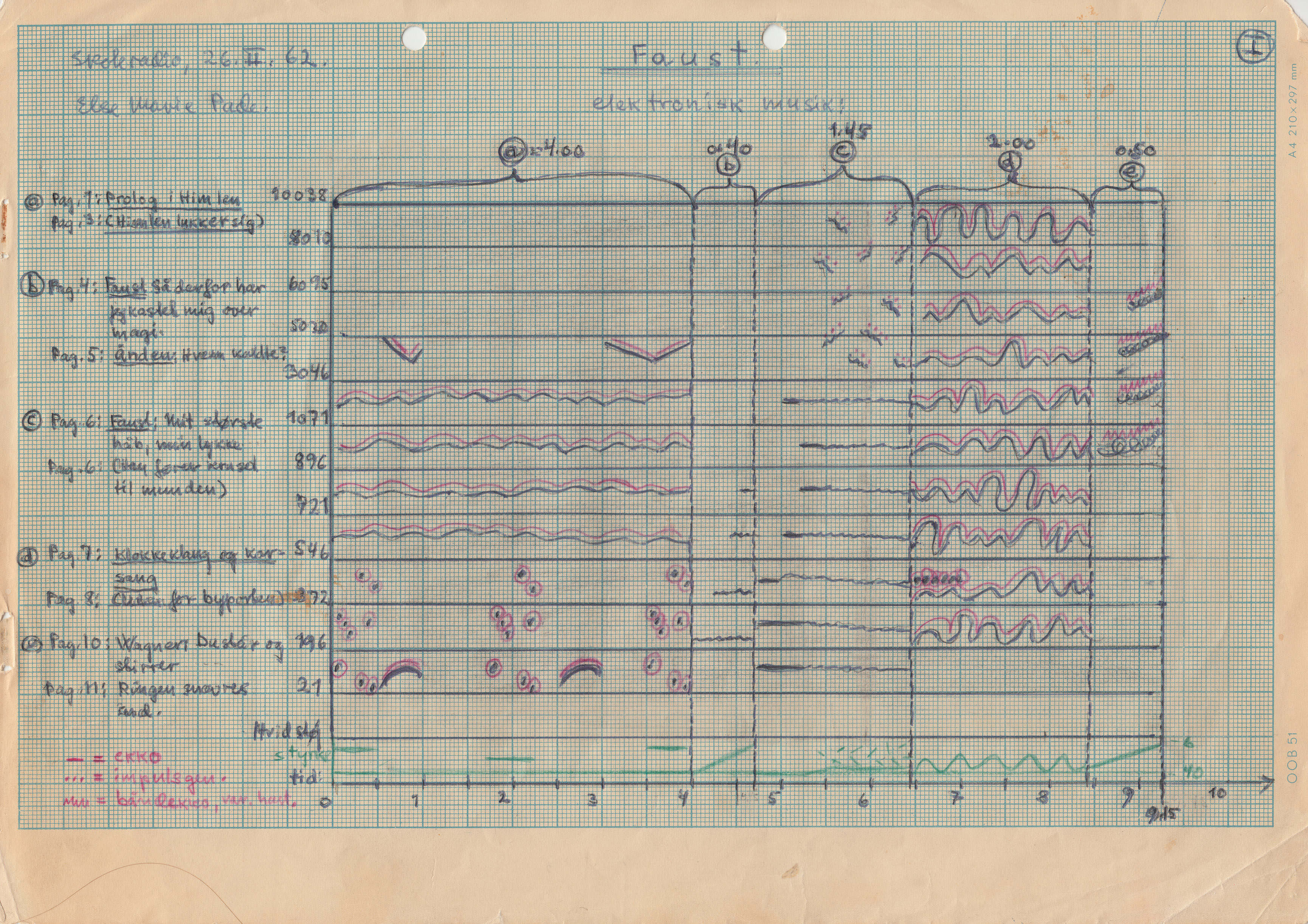
Else Marie Pade (2 December 1924 – 18 January 2016) was a Danish composer. After classical music studies at the Royal Academy of Music in Copenhagen, her life changed and her mind was turned in 1952 when she listened a Pierre Schaeffer's piece on a radio broadcast.
score of Faust
"Syv Cirkler" (seven circles)is an electronic sound constellation consisting of layers of sine
tones in an age that knew neither the computer nor the sampler.
“My work "7 Circles" was inspired directly by my trip to the
World Exhibition in Brussels in 1958 (…) I was sitting in a planetarium
and saw their programme, which consisted of various compositions,
accompanied by light and movement in the planetarium dome...
There was one composition that completely captured me because it
represented the stars, how they walk across the sky and their relation
to each other. I remember that feeling that I was being lifted into the
room, as if I was part of the movement – afterwards I almost felt a
little seasick. It all continued to tumble around in my head for quite
some time, and when I got back home, I knew that I would write a piece
that would be called 7 Circles“ Else Marie Pade - Life in a Glass Bead Game (2005)
"For Cornelius" is a piece composed by Alvin Curran in 1981. It
was Curran's first release of fully composed music performed by other
people, his earlier LPs containing semi-improvised solo electroacoustic
works performed by Curran himself.
It was written shortly after the death of Cornelius Cardew in 1981, the great british composer and political firebrand.
Curran has some additional notes about the piece at his website: <<<>>>
"For Cornelius" is performed here by Ursula Oppens.
It was an experimental framework for exploring the methodologies, technics, and spirit of the "Scratch Orchestra", originaly founded in July 1969 by Cornelius Cardew, growing out of a series of music composition
classes held at Morley College London that were attended by avant-garde
musicians as well as artists interested in exploring sound.
This
three-day public workshop involving more than 20 students proposed a journey through two important works of the
orchestra: Nature Study Notes (1969) and Scratch Cottage (1971).