Fausto Romitelli (1963 / 2004) was an italian young composer who studied with Franco Donatoni, moved to Paris to meet Hugues Dufourt & Gérard Grisey, and worked at IRCAM. He unfortunately had a brief career but wrote some amazing pieces that I highly recommand: notably "An index of metals" (2003) & "Professor bad trip - lesson I" (1998)
« Depuis que je suis né, je baigne dans les images digitalisées, les sons synthétiques, les artefacts. L’artificiel, le distordu, le filtré – voilà ce qu’est la Nature des hommes d’aujourd’hui. » Fausto Romitelli
"Mikrophonie 1" is a piece for tam-tam, 2 microphones and 2 electronic filters and controlers, created by Stockhausen in 1964. In this live piece, "the microphone is used actively as a musical instrument, in contrast to its former passive function of reproducing sounds as faithfully as possible" (K.S. 1971): just to reveal "inaudible vibrations", by an active process of sound detection.
"Mikrophonie 1" est une œuvre pour tam-tam, deux microphones ainsi que deux filtres et contrôleurs électroniques, créée par Stockhausen en 1964. Dans cette pièce pour concert, "le microphone est utilisé activement comme un instrument de musique, contrairement à sa fonction passive antérieure consistant à reproduire les sons aussi fidèlement que possible" (K.S. 1971) : il s'agit de révéler des "vibrations inaudibles" grâce à un processus actif de captation sonore.
- - -
Stockhausen decided to categorize the sounds according to their
perceived qualities: groaning, trumpeting, whirring, hooting, roaring, grating, chattering, wailing, sawing, ringing, choking, cawing, clacking, snorting, chirping, hissing, grunting, crunching, clinking, tromboning, scraping ...
(c.a.d. en français : gémir, claironner, vrombir, huer, rugir, griller, bavarder, se lamenter, scier, sonner, suffoquer, croasser, claquer, renifler, gazouiller, siffler, grogner, croquer, cliqueter, tromboner, gratter... )
"Mikrophonie 1", a pure piece of jewel : enjoy!
"I searched for ways to compose — flexibly — also the process of microphone
recording. The microphone . . . would have to become a musical
instrument and, on the other hand, through its manipulation, influence all
the characteristics of the sounds. In other words, it would have to
participate in forming the pitches — according to composed
indications — harmonically and melodically, as well as the rhythm, dynamic
level, timbre and spatial projection of the sounds." (K.S. 1971)
"J'ai cherché des moyens de composer — de manière flexible — le processus même de la prise de son au microphone. Le microphone... devait devenir un instrument de musique et, par sa manipulation, influencer toutes les caractéristiques des sons. En d'autres termes, il devait participer à la formation des hauteurs — selon des indications compositionnelles — tant sur le plan harmonique que mélodique, ainsi qu'à celle du rythme, de la dynamique, du timbre et de la projection spatiale des sons."(K.S. 1971)
"Pianiste formé au conservatoire de Strasbourg (classes d'écriture et de
musique de chambre), il a longtemps détesté... toute la musique de ces
cinquante dernières années ! Il éprouvait même des difficultés à entrer
dans l'oeuvre de Claude Debussy, un comble pour un pianiste ! Un beau
jour, la curiosité l'a tout de même poussé à acheter un enregistrement
de musique contemporaine.... le hasard l'a
fait choisir le "Concerto de chambre", de Ligeti. Une révélation absolue. "Déblocage, plutôt", tempère-t-il... La musique de Christophe Bertrand est toujours placée sous le signe d'une haute virtuosité... avec une même fulgurance de la geste instrumentale; le même déluge sonore qui
enfle jusqu'à donner un sentiment de rupture ou d'explosion; la même
tension inquiète zébrée d'éclairs. Et surtout, la même minutie
implacable de la forme, ciselée au micro-intervalle près, toujours
soumise à des contraintes précises"source
Christophe Bernard, élève de Ivan Fedele, est un formidable compositeur à la brève carrière et au catalogue impressionnant, dont j'ai eu le plaisir d'entendre "La chute du rouge" interprété dans le cadre de ARCo-23 au GMEM par 4 musiciens des membres du collectif "Ensemble Multilatérale"
Birds on telegraph lines are defining a score for prepared piano samples.
A creation by Kathy Hinde & Ivan Franco.
***&***
"… the standout experience is an audiovisual installation by Kathy
Hinde: an ingenious music box, in which video of flittering birds on six
electricity lines becomes an ever-changing score, their come-and-go
presence triggering cracks and clicks in the guts of a piano
mechanism. It’s somehow completely alive, and you could relax in its
company for hours."
The Venue Magazine
pic by Nicola Easterby
And "piano migrations" in which video of flittering birds become an ever-changing score.
“In a decaying society, art, if it is truthful, must also reflect[s] decay.” – Ernst Fischer
"Decomposition study" is a collaborative process initiated by the artist Ed Williams. The instrument featured here is an
arciorgano, a special microtonal organo di legno with two manually
operated bellows and 36-key octaves across two manuals, constructed
according to Nicola Vicentino’s designs from 1555. The notes of the
music, written according to the rules of canonic contrapunto alla mente,
are passed between two organists while four other musicians disrupt and
amplify the organ’s airflow, acting similarly to cellular enzymes in
decaying organisms during the decompositional process called autolysis.
The music is decomposed as it is played, re-composed as it is heard.
"Decomposition study" est un processus collaboratif composé par le musicien Ed Williams. L’instrument employé
ici est un arciorgano ; un organo di legno microtonal avec deux
soufflets que l’on opère manuellement, ainsi que des octaves de 36
touches à travers deux claviers, construit selon les dessins de 1555 de
Nicola Vicentino. Les notes de la musique, écrite selon les règles de
contrapunto alla mente en canon, sont passées entre les deux
joueurs de l’orgue pendant
que quatre autres musiciens perturbent et amplifient
l’écoulement d’air de l’orgue. Ainsi, ils agissent de manière analogue
aux enzymes cellulaires à l’intérieur des organismes en décomposition
pendant le processus nommé autolyse. La musique se décompose dans le
jeu, se ré-compose dans l’écoute.
"My first experiences with the organ date from before I can remember, according to a photo of me as a baby sat at the keyboard of a small pipe organ we had at the house, my father standing behind to provide harmonic support to dissonances that my cuteness could surely only just cover up. My dad was an organist and musicologist, and the organ has always represented for me the weight of authority from the past. This is a ghostly weight, a fog, which can be heard in the timbre of the flue pipes themselves. And in my ears this mingles with the fog of memory from the innumerable times I heard my dad practicing in the house and performing. He taught me the basics of organ playing on the local village church organ when I was a teenager. When I started university I would return to this same instrument in the summer holidays and experiment pulling out stops only partially and combining different registers. I liked it particularly when the entire case would shake from all the 16’ pipes sounding simultaneously. Aside from this and an attempt at recreating these effects at the experimental and early music festival Bach to the Future in Providence, RI, USA I didn’t have much to do with organs until I took up studies at the Hochschule für Musik, Basel, and discovered the Arciorgano there, the only extant instrument of its kind built in 2016 according to Nicola Vicentino’s designs from 1555. This instrument provided an open door back into the sound world of the organ in which I could push my experimentation even further into the realms of microtonality and distortion. The first piece I composed using this instrument was a way for me to experiment with decomposition as a generative, compositional process. At the invitation of Caspar Johannes Walter, I had the opportunity to write a second decomposition study to incorporate the timbre-bending capabilities of the Experimentalmodul at St. Martinskirche, Kassel. Like anything I will do with the organ, this project is also a way of dealing with grieving for my late father whose ghost will always be standing behind me giving harmonic support to my dissonances." Ed Williams - Dec 2022
Mes premières expériences avec l'orgue datent d'avant mes souvenirs, d'après une photo de moi bébé assis au clavier d'un petit orgue à tuyaux que nous avions à la maison, mon père se tenant derrière pour apporter un soutien harmonique aux dissonances que mon côté mignon ne pouvait sûrement que couvrir. Mon père était organiste et musicologue, et l'orgue a toujours représenté pour moi le poids de l'autorité du passé. C'est un poids fantomatique, un brouillard, qui s'entend dans le timbre des tuyaux de l'orgue eux-mêmes. Et dans mes oreilles, cela se mêle au brouillard du souvenir des innombrables fois où j'ai entendu mon père s'entraîner à la maison et jouer. Il m'a appris les bases de l'orgue sur l'orgue de l'église du village local quand j'étais adolescent.
Quand j'ai commencé l'université, je retournais à ce même instrument pendant les vacances d'été et j'expérimentais en ne retirant que partiellement les jeux et en combinant différents registres. J'aimais particulièrement quand tout le boîtier tremblait à cause de tous les tuyaux de 16' qui sonnaient simultanément.
Mis à part cela et une tentative de recréation de ces effets au Festival de Musique expérimentale et ancienne Bach to the Future à Providence, USA, je n'avais pas grand-chose à voir avec les orgues jusqu'à ce que j'entreprenne des études à la Hochschule für Musik, Bâle, et j'y ai découvert l'Arciorgano, le seul instrument existant de ce type construit en 2016 selon les plans de Nicola Vicentino de 1555. Cet instrument a ouvert une porte sur le monde sonore de l'orgue dans lequel j'ai pu pousser mon expérimentation encore plus loin dans les royaumes de microtonalité et de distorsion. La première pièce que j'ai composée avec cet instrument était pour moi une façon d'expérimenter la décomposition en tant que processus de composition génératif. À l'invitation de Caspar Johannes Walter, j'ai eu l'occasion d'écrire une deuxième étude de décomposition pour incorporer les capacités de flexion du timbre de l'Experimentalmodul à St. Martinskirche, Kassel. Comme tout ce que je ferai avec l'orgue, ce projet est aussi une façon de faire face au deuil de mon défunt père dont le fantôme se tiendra toujours derrière moi pour soutenir harmoniquement mes dissonances. Ed Williams - Dec 2022
Performed and recorded on March
28, 2022 at the Hochschule für Musik, Basel, on the arciorgano and
amplified through a 6-faced “Cube” speaker, with the 'Enzymes' Abel Fazekas, Noah Rosen, Miriam Paschetta and Ed Williams & , as organ players, Christoph Schiller and Anna-Kaisa Meklin
Andrzej Dobrowolski (1921-1990) est un compositeur polonais parmi les premiers à créer des pièces pour bande magnétique après s’être engagé dans les activités
et aussi, plus tard, à l’Institut für Elektronische Musik à Graz, en Autriche.
Le matériel sonore utilisé pour cette première pièce sur bande provient de sources hétérogènes (générateurs de fréquences, toutes sortes de sons générés par un piano, voix manipulés électroniquement …), malgré le fait que la pièce elle-même ait un caractère homogène.
________
”La Passion selon Sade” - 1965 Sylvano Bussotti (octobre 1931 - septembre 2021) ”La Passion selon Sade” est un ”Mystère de chambre avec tableaux vivants”.
La création de cette oeuvre mythique tout autant que sulfureuse
au Teatro Biondo à Palerme le 5 septembre 1965 suscite un scandale,
tout autant qu’à Paris lors de sa reprise peu après sa création.
________
”Dimensioni III” (1963 - 1965) pour orchestre avec cadence pour flûte solo
Bruno Maderna (1920 - 1973), chef d’orchestre et compositeur, faisant partie des avant-gardes italiennes au côté de Luciano Berio et Luigi Nono, compose cette pièce d’une durée variable destinée à être combinée avec deux autres de ses compositions.
Dedicated to Maurizio Kagel, "Etude N°9" for piano was created by Ligeti circa 1990, using chromatic scales to create a sensation of fall without end. Influenced by the works of Conlon Nancarrow for mechanical piano, he wanted "unplayable" arrangements.
"Vertige" (title of etude N°9) was transcribed for the Player Piano under the direction of Ligeti himself.
Joseph Nicolas Pancrace Royer est un compositeur et claveciniste né à Turin en 1703 et mort à Paris en 1755. Après Domenico Scarlatti, François Couperin et Jean-Philippe Rameau, auteurs incontestables de sérieux volumes de compositions pour clavecin, Pancrace Royer travaille à partir de 1746 à l'introduction de pièces novatrices pour cet instrument, pièces réunies après sa mort en 1775 sous la forme d'un "Recueil de pièces détachées".
"Sa Majesté (Louis XV) étant satisfaite des talents et de la capacité du Sr. Royer" le 15 novembre 1734, le jeune auteur obtient le brevet de la charge
de maître de musique des enfants de France qu’il partagera avec
Jean-Baptiste Matho. Par la suite, on lui concède en 1748 la charge du "Concert spirituel".
Après sa mort, Pancrace Royer tombe dans un oubli qui n’a d’égal que la soudaineté de son décès. Cependant, dans son "Dictionnaire des artistes" de 1776, l’abbé de Fontenai, écrivain et journaliste, loue la politesse et l’amabilité de son caractère, s’étant "fait connaitre d’abord par la manière savante et délicate dont il touchait l’orgue et le clavecin".
Joseph Nicolas Pancrace Royer is a composer and harpsichordist born in Turin in 1703 and died in Paris in 1755. After Domenico Scarlatti, François Couperin and Jean-Philippe Rameau, indisputable authors of serious volumes of compositions for harpsichord, From 1746, Pancrace Royer’ works operate as an introduction of innovative parts for this instrument. His works were collected after his death in 1775 in the form of a "Recueil de pièces détachées". "His Majesty (Louis XV) being satisfied with the talents and the capacity of Sr. Royer" on November 15, 1734, the young author obtains the certificate of the charge of music master of the children of France which he will share with Jean-Baptiste Matho. Subsequently, in 1748 he was granted the charge of the "Concert spirituel". After her death, Pancrace Royer falls into oblivion that is matched only by the suddenness of her passing. However, in his "Dictionnaire des artistes" of 1776, l' abbé de Fontenai, writer and journalist, praises the politeness and the friendliness of his character, having "made himself known first by the learned and delicate manner in which he touched the organ and the harpsichord ".
"Le Vertigo", une pièce inouïe faisant appel à une grande virtuosité.
Sur le clavecin historique du château d’Assas, Jean Rondeau
qui trouve le juste ton pour l'interpréter nous rappelle que les cordes dans un clavecin, sont des cordes métalliques!
"Le Vertigo" is an incredible piece calling on great virtuosity.On the historic harpsichord of the château d’Assas, Jean Rondeau, who finds the right way to interpret it, reminds us that the strings in a harpsichord are metal strings!
et aussi, pour les amateurs de clavecin, ne pas oublier le répertoire contemporain avec Elisabeth Chojnacka
for lovers of harpsichord, don't forget the contemporary repertoire with Elisabeth Chojnacka
The original manuscript of Samuel Beckett’s Watt, was written in ink
and colored crayons between 1940 and 1945. The six notebooks features
many changes, deletions, mathematical calculations, rhyming indications
and drawings.
The first page of the third notebook of Watt shows the date “5.5.42
Written in Roussillon, south of France, this second Beckett's novel was published in 1953, with a french translation followed in 1968.
who is able to identify the 2 musics above which are supposed to be played?
The winner will have our eternal admiration.
A 1904 Lochmann Original 450 disc piano. The perforated disc pictured
here, along with other mechanisms, plays the piano strings seen behind
the disc.
perforated cardboard for “Ariston” hand organ
"...The invention of disk music boxes made it affordable for many people
to enjoy a variety of songs played on a music box at home. These discs
were large and measured approximately 15 1/2″ in diameter. The disc
pictured here was manufactured in 1889. The musical notes on the disc
are represented by raised projections on a metal disk. Although still in
limited production today (mostly for antique collectors and specialty
applications), in general the production of these discs ceased around
1920..." in"History of audio formats"
__--__--__
a Trimpin monotype
Trimpin, born in 1951, is a German sound artist currently living in Seattle (USA).
“An ongoing exploration of the
concepts of sound, vision, and movement.” - Trimpin
For 40 years, his work integrates sculpture and sound across a variety of media including
fixed installation and live music, theater, and dance performance.
Combining ancient methods with
scientific principles and XXIth century's technology,
he
experiments, combining music, sounds and mechanics that introduce the
senses of perception to a totally new experience.
Trimpin build numerous strange instruments as a gamelan whose iron bells are suspended in air by electronic magnets, a microtonal xylophone and machines to play every instrument of the orchestra via MIDI commands.
He is largely credited for preserving Conlon Nancarrow's perforated piano-roll scores.
”En
tout état de cause, ce n’est pas le dessin qui est éternel, mais la
ligne; non la peinture mais la couleur; ce n’est pas le poème, c’est le
rythme; ni la musique, ni la sculpture mais le son, la masse.” FRANÇOIS DUFRÊNE
Hans Haass (1897-1955)
Final d’une fugue pour piano mécanique (sur rouleau)
"Beyond the coda" s'est bien sûr penché depuis longtemps sur cette question des partitions graphiques; quelques posts sur le sujet Ici
et pour finir,
cette partition de scratch du DJ Rob Swift
Skratchin’ par DJ Rob Swift
” … De même, la pratique du scratch ayant comme instrument la platine et les disques, n’est à priori pas sujette à l’établissement d’une notation. La culture DJ est maintenant courante et reconnue. Le scratch dispose aujourd’hui de son propre système d’écriture: le TTM …” TTM (turntablist transcription methodology) est une organisation dédiée à l’avancement de la platine comme instrument et au DJ comme musicien. Elle se concentre sur la création et l’évolution d’un système de notation permettant de documenter la composition et les nuances des compositions des DJs.
"Chers Amis Du Meubler Perdu, Chers auditeurs" is a performance by Claus Böhmler recorded by Holger Hiller in 1984
Claus Böhmler, born in 1939, is a german Fluxus artist and media-scientist, working with video, drawing and modern techniques of image reproduction. He lives and works in Hamburg.
This crazy piece is based on avocal performance in German, English and French
"Thema (Omaggio a Joyce)"is an amazing composition by Luciano Berio, using tape and the voice of Cathy Berberian, his wife, the intense and unique contemporary avant-garde music vocalist. Words are issued from chapter XI "Les Sirènes" of "Ulysses", the James Joyce's famous novel. As an electroacoustic composition, the piece uses the possibilities of combining phonemes and the meaning of sounds that Joyce used in his text.
A first version, titled "Omaggio a Joyce. Documenti sulla qualità onomatopeica del linguaggio poetico" was for a radio documentary and was build at "Institute of Musical Phonology", in Milan, Italy. Initially conceived for four audio channels, this version was finaly recorded in stereo in 1958 under the title "Thema (Omaggio a Joyce)" and published on a Turnabout' LP. In 1995, it was digitally restored as the definitive version.
"... I tried to interpret musically a reading of Joyce’s text, developing the
polyphonic intent that characterizes the eleventh chapter of Ulysses
(entitled “Sirens” and dedicated to music), whose narrative technique
was suggested to the author by a common procedure of polyphonic music:
the fuga per canonem..."
Luciano Berio
Luciano Berio & Cathy Berberian
***
"... par les moyens électroniques, le compositeur multiplie les bribes-mots,
décompose et recompose les énoncés continus, les déforme (jusqu'à
l'abstraction totale, fouillis de gazouillis et pépiements, souffles),
en les manipulant selon des critères d'organisation différents de
l'écriture du texte (par essence contraint par la nécessaire
signifiance), en variant les vitesses, les durées et les bandes de
fréquences..."
"Shetàbàn", a piece for viola solo played by Hannah Nicholas.
Sahba Aminikia is an Iranian-American composer born in Tehran in 1981.
Trained in music by Persian pianists as Safa Shahidi and Gagik Babayan, in Russia at the St. Petersburg Stat Conservatory by Boris Ivanov Tishchenko, and in England by Sir Michael Tippett, he is now living in California.
"Life in Tehran taught me to appreciate
hardship and beauty at the same time, and this is something that, due to
heavy media propaganda, is mainly obscured in Western minds. I was
brought up with the poetry of Hafiz, Rumi, and Saadi, and with Persian
classical music, but was also largely exposed to the music of Pink
Floyd, Beatles, Queen, and various jazz musicians. This conflict between
the morals of a theocracy and Western cultural imports also exists in
my mind, and I see it as a life process towards finding a common ground
for communication and dialogue in my music." Sahba Aminikia
He wrote numerous orchestral, vocal and solo pieces performed all around the world, with famous orchestras and musicians. He has been commissioned by theater companies, contemporary classical ensembles, film scores, Persian traditional music groups as well as jazz bands including Kronos Quartet, Symphony Parnassus, Mobius Trio, San Francisco Conservatory of New Music Ensemble and many others.
*** The amazing CD "Miniatures" was published by the iranian Hermes Records.
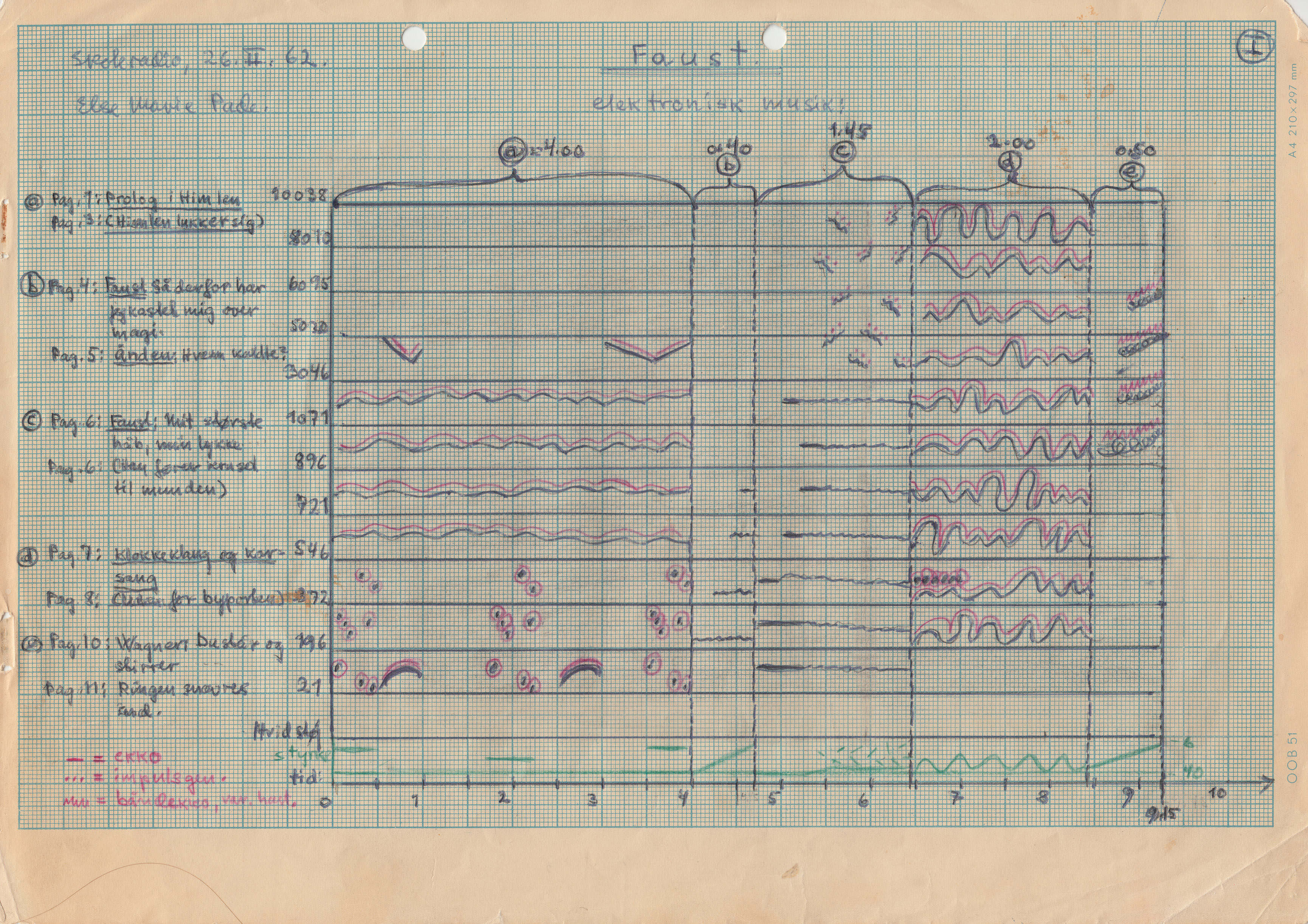
Else Marie Pade (2 December 1924 – 18 January 2016) was a Danish composer. After classical music studies at the Royal Academy of Music in Copenhagen, her life changed and her mind was turned in 1952 when she listened a Pierre Schaeffer's piece on a radio broadcast.
score of Faust
"Syv Cirkler" (seven circles)is an electronic sound constellation consisting of layers of sine
tones in an age that knew neither the computer nor the sampler.
“My work "7 Circles" was inspired directly by my trip to the
World Exhibition in Brussels in 1958 (…) I was sitting in a planetarium
and saw their programme, which consisted of various compositions,
accompanied by light and movement in the planetarium dome...
There was one composition that completely captured me because it
represented the stars, how they walk across the sky and their relation
to each other. I remember that feeling that I was being lifted into the
room, as if I was part of the movement – afterwards I almost felt a
little seasick. It all continued to tumble around in my head for quite
some time, and when I got back home, I knew that I would write a piece
that would be called 7 Circles“ Else Marie Pade - Life in a Glass Bead Game (2005)
Ashley Fure compose acoustic and
electroacoustic music as well she build multimedia installation art.
Her work explores the kinetic source of sound, bringing focus to the
muscular act of music making and the chaotic behaviors of raw acoustic
matter.
"The force of things" is an immersive work of music theater that wrestles with the animate
vitality of matter and the mounting hum of ecological anxiety around us.
Audience members are invited into a field of sculpted matter circled by a
ring of subwoofer speakers projecting subaudible frequencies. Though
the sounds they emit are too low for humans to hear, the vibrations
these subwoofers push into the air cause disturbances to ripple through
the material infrastructure of the piece. Players slide the flesh of
their palms and the surface of objects against these speaker cones while
they shake, drawing them into the realm of audibility through touch.
Two singers snake side-by-side throughout the space, shouting a warning
that sounds like a whisper in a language no one can understand.