" – Peu importe d’où l’on vient. Il n’y a pas de tonique. Le thème et son développement ne sont qu’un mirage…
Il y a une musique toujours inattendue.
– Et les dissonances ?
– Dieu les a créées, elles aussi…"
Jaume Cabré - "Voyage d'hiver" - 2014

”La terre, il se pourrait bien après tout que ce soit une espèce
de merveilleux petit appareil enregistreur, plaçé là par on ne sait qui,
pour capter tous les bruits qui circulent mystérieusement dans l’Univers.”
Pierre Reverdy - ”En vrac” - 1929

”J’entends tous les bruits de la terre grâce à mes oreilles et mes nerfs de cristal
dans lesquels circulent le feu du ciel et celui des volcans.”
Michel Leiris - ”Le point cardinal” - 1927

"L'écoute, c'est l'ombre de la composition"
Pascal Dusapin - 2008


07/12/2017

05/12/2017

Sismographie des luttes (2)


Quelques couvertures de "revues de luttes" évoquant la musique et le monde du sonore.
Le fruit de recherches de plusieurs chercheurs et l'objet de l'exposition à ne pas manquer:

"Sismographie des luttes"
vers une histoire globale des revues critiques et culturelles.


Du 10 novembre 2017 au 20 janvier 2018 - 14H30 / 19H30
du mardi au samedi

Galerie Colbert, salle Roberto Longhi -
INHA - Institut national d’histoire de l’art
2 rue Vivienne  ou  6 rue des Petits Champs - 75002 Paris

entrée libre

African Arts - 1968`


  African Arts - 1970


 Amauta (Pérou) - 1928


  Amis du Laos - 1987


 Les cahiers de la Réunion  - 1976


Disco (Argentina) - 1945/1947


 Drum (South Africa) - 1955


 La Lira Chilena (Chili) - 1906


  Megafono (Argentina) - 1931


Mexican Folkways - 1930

 
Rohani (revue Kurde) - 1945

 
La voix du Congolais - 1952


Klaxon - may 1922


***
 

02/12/2017

Sergey Khismatov


Sergey Khismatov, born 21 February 1983 in St. Petersburg, is a composer gradueted at European University in St. Petersburg.
He participated in workshops and open lectures of composers such as Boris Filanovsky, Pascal Dusapin, Sandeep Bhagwati, Enno Poppe, Helmut Lachenmann.
He composes for voices, instrumental ensemble and experimental electroacoustic experiences, as a quatuor for 4 performers and 4 microphones and a piano.

He also rebuild the famous Arseny Avraamov's "Symphony of industrial horns"  in Athens for Documenta 14.

To listen to his music: his Soundcloud: <<<here>>>

Don't miss "Quasar" for organ and accordion


and this version of "Microphones quartet" live at Paradiso in Amsterdam in 2012

28/11/2017

Interim


"Interim" is a Stan Brakhage (1933 - 2003)  film, directed in 1952.

Inspired by Italian Neo-Realism and relatively conventional in structure compared to his later works, this first  Brackhage's film suggests a tentative encounter between a teenage boy and girl who meet under the city viaducts.
The young man meets the young woman under a bridge by a railroad. They shelter from the rain and exchange a kiss. The man grows sullen and leaves. The film starts with him and ends with her. 
The music is composed by James Tenney.  


***

24/11/2017

Tomeka Reid

http://www.tomekareid.net/

Tomeka Reid  is a Chicago based cellist, composer and educator.
Equally adept in classical and jazz contexts, Tomeka Reid  predominantly finds herself in experimental and improvisatory settings and composes for a wide range of instrumentation, from big band to chamber ensemble. Her music combines her love for groove along with freer concepts.

” (…) I’m loving to perform purely free these days. That used to be such a source of anxiety for me ... to be so naked and create something from nothing in front of people and sometimes with people I’ve never improvised with! (…) Do I solo? Do I become a member of the rhythm section? What can I do to make something happen? (…) I like being pushed and even though I am sometimes stubborn, I like to be forced out of my comfort zone (…) I also enjoy through-composed settings and pieces with structure that include improvisation. It’s nice to know where you’re going sometimes but it’s also really nice to know that if you end up somewhere else that’s ok too! (…)”  
 Tomeka Reid - 2015


A long interview by Troy Collins to read here

"(...) Chicago-based AACM member Tomeka Reid has honed her improvisational skills for the past decade and a half as a sideperson to such luminaries as Anthony Braxton, George Lewis and Roscoe Mitchell, as well as contemporaries like Dee Alexander, Nicole Mitchell and Mike Reed. She also co-leads Hear in Now, a string trio with New York-based violinist Mazz Swift and Italian bassist Silvia Bolognesi. Reid is poised to become one of the preeminent improvising cellists of her generation with the eponymous release of Tomeka Reid Quartet, her first album as a bandleader (...)"
Troy Collins 

*******

in quartet with Mary Halvorson (guitar), Tomas Fujiwara (dms) and Jason Roebke (dble bass),
a tribute to the violin player Billy Bang


& here with the live piece  "Tokens"  at the Hyde Park Jazz Festival in 2015
played by six strings' players and a drummer 
Amazing!

20/11/2017

Circles (2)


all these pictures are "astrology digital art" pieces created by David Mrugala
ansd issued from a study of planets and NASA informations.

&

"Sound of Uranus" is made with code (Processing) based on the recording of the Voyager 1 and 2 spacecraft that passed near different planetary and moon bodies within our solar system. Voyager 1 and 2 were launched in 1977 by NASA.

18/11/2017

Syv Cirkler


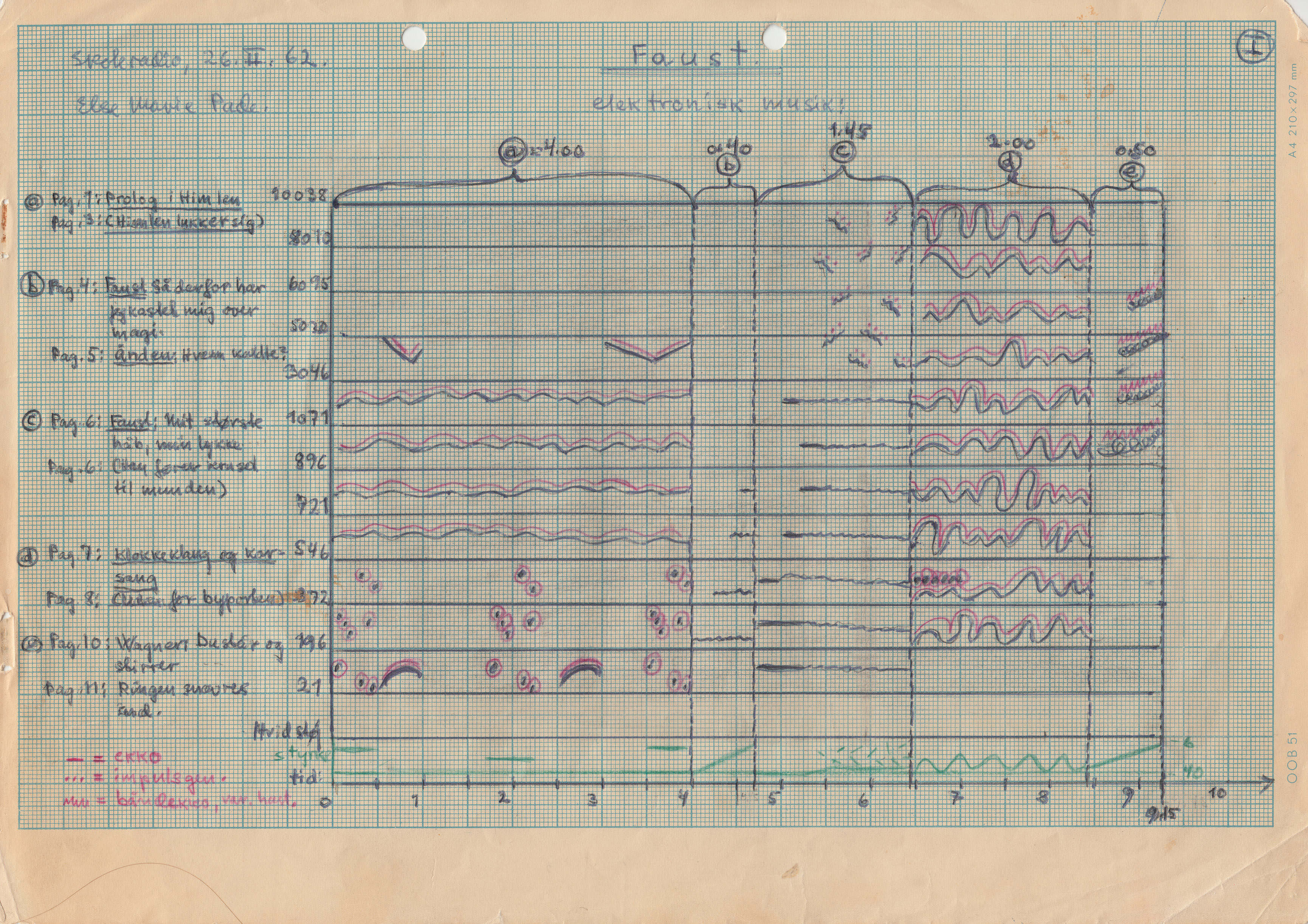
Else Marie Pade (2 December 1924 – 18 January 2016) was a Danish composer. After classical music studies at the Royal Academy of Music in Copenhagen, her life changed and her mind was turned in 1952 when she listened a Pierre Schaeffer's piece on a radio broadcast.


https://d14wch1fpzoq5q.cloudfront.net/npl/2014/11/sFaust-Else_Marie_Pade1.jpg
score of Faust 

"Syv Cirkler" (seven circles) is an electronic sound constellation consisting of layers of sine tones in an age that knew neither the computer nor the sampler.

“My work "7 Circles" was inspired directly by my trip to the World Exhibition in Brussels in 1958 (…) I was sitting in a planetarium and saw their programme, which consisted of various compositions, accompanied by light and movement in the planetarium dome...
There was one composition that completely captured me because it represented the stars, how they walk across the sky and their relation to each other. I remember that feeling that I was being lifted into the room, as if I was part of the movement – afterwards I almost felt a little seasick. It all continued to tumble around in my head for quite some time, and when I got back home, I knew that I would write a piece that would be called 7 Circles“
Else Marie Pade - Life in a Glass Bead Game (2005)
   

To read: a 2014's conversation between Jacob Kirkegaard and Else Marie Pade here

& to listen to: "Syv Cirkler", claimed as the first danish electronic music in Danemark

08/11/2017

For Cornelius


"For Cornelius" is a piece composed by Alvin Curran in 1981. It was Curran's first release of fully composed music performed by other people, his earlier LPs containing semi-improvised solo electroacoustic works performed by Curran himself.

It was written shortly after the death of Cornelius Cardew in 1981, the great british composer and political firebrand. Curran has some additional notes about the piece at his website: <<<>>>

"For Cornelius" is performed here by Ursula Oppens.

 ********************************************************

& about Cornelius Cardew these last months:

"Scratch Cottage and Nature Study Notes", with Carole Finer and Stefan Szczelkun, original "Scratch Orchestra" members, who did activate an intervention, curated by Pierre Bal-Blanc, as part of the last "Documenta 14" in the basement of the Athens conservatory.
It was an experimental framework for exploring the methodologies, technics, and spirit of the "Scratch Orchestra", originaly founded in July 1969 by Cornelius Cardew, growing out of a series of music composition classes held at Morley College London that were attended by avant-garde musicians as well as artists interested in exploring sound. 
This three-day public workshop involving more than 20 students proposed a journey through two important works of the orchestra: Nature Study Notes (1969) and Scratch Cottage (1971)


30/10/2017

The Force of Things


"The force of things" is an opera for objects.

Composed by Ashley Fure, with the complicity of his brother architect, Adam Fure, this piece was first performed in 2016 at the Darmstadt Summer Courses for New Music.

Ashley Fure compose acoustic and electroacoustic music as well she build multimedia installation art. Her work explores the kinetic source of sound, bringing focus to the muscular act of music making and the chaotic behaviors of raw acoustic matter.  

 
"The force of things" is an immersive work of music theater that wrestles with the animate vitality of matter and the mounting hum of ecological anxiety around us. 
Audience members are invited into a field of sculpted matter circled by a ring of subwoofer speakers projecting subaudible frequencies. Though the sounds they emit are too low for humans to hear, the vibrations these subwoofers push into the air cause disturbances to ripple through the material infrastructure of the piece.  Players slide the flesh of their palms and the surface of objects against these speaker cones while they shake, drawing them into the realm of audibility through touch. Two singers snake side-by-side throughout the space, shouting a warning that sounds like a whisper in a language no one can understand.  


25/10/2017

San Francisco

 
"San Francisco" (1968) is a movie directed by the experimental film-maker Anthony Stern, born in Cambridge, England in 1944.
To be seen as a psychedelic explosion of iconic imagery seen from the perspective of this English director, at the time of Flower Power, anti-Vietnam protest and counterculture.

As Syd Barrett was a friend of Anthony Stern, the soundtrack is an amazing unreleased version of Pink Floyd’s "Interstellar Overdrive" .

"Anthony Stern était l’un des secrets les mieux gardés de la cinématographie anglaise. La Cinémathèque française lui offre sa première rétrospective. Camarade de classe de Syd Barrett et de David Gilmour, assistant de Peter Whitehead, Anthony Stern a réalisé certains des plus beaux poèmes documentaires des années 60 et 70, à la fois sensuels, endiablés et railleurs. Son sens du rythme hors du commun continue de dynamiser ses films récents, montage des rushes tournés en 16mm dans l’Afghanistan de 1971, ou festival de Jazz à Cuba. Aujourd’hui célèbre en tant que maître-verrier, Anthony Stern nous offre aussi des images totalement inédites de Mick Jagger et autres icônes musicales."
in program of a retrospective in 2008  by French Cinemathéque in Paris


*_*_*