" – Peu importe d’où l’on vient. Il n’y a pas de tonique. Le thème et son développement ne sont qu’un mirage…
Il y a une musique toujours inattendue.
– Et les dissonances ?
– Dieu les a créées, elles aussi…"
Jaume Cabré - "Voyage d'hiver" - 2014

”La terre, il se pourrait bien après tout que ce soit une espèce
de merveilleux petit appareil enregistreur, plaçé là par on ne sait qui,
pour capter tous les bruits qui circulent mystérieusement dans l’Univers.”
Pierre Reverdy - ”En vrac” - 1929

”J’entends tous les bruits de la terre grâce à mes oreilles et mes nerfs de cristal
dans lesquels circulent le feu du ciel et celui des volcans.”
Michel Leiris - ”Le point cardinal” - 1927

"L'écoute, c'est l'ombre de la composition"
Pascal Dusapin - 2008


06/07/2017

No world


Winter Family est un duo composé de Ruth Rosenthal et Xavier Klaine en 2004.
En 2012, à New-York, leur matériel est noyé par l’ouragan Sandy.
Ils se procurent alors de vieux synthés, une boite à rythme d’autrefois et alors les chansons de leur nouvel album ”South from here” sonnent comme dans les années 80,  convoquant parfois les esprits d’Alan Vega et de Kas Product.
Toujours nappé d’un sombre pessimisme, leur univers sonore dégage malgré tout une étonnante énergie.

"...Winter Family's songs touch on topics like war and religious zealotry....Brittle pianos or velvety harmonium create twinkles and warmth—every track feels like it could crumble, presumably because the world can." Christopher Weingarten, The Village Voice.


"No World" is an original piece in an audio book published in France by Dis Voir.
It is composed from daily images, sounds and texts collected through the Internet, songs, poems, interviews and field recordings created by Winter Family between 2011 and 2014 while living between Paris and in the Caribbean neighbourhoods of Brooklyn, NYC.

http://www.disvoir.com/an/fo/a/216.html


"No world
the world is her home and she knows
every road, every turn, every spot
when she looks in the mirror
she see them, million twin sisters,
all look the same
same hair, same dress, same smile
tastes become sweeter, colors reduce their range
she likes them all
no dangerous corners, no sharp edges, no threats
the world is her home and it’s beautiful
the world is her home and it’s beautiful"


04/07/2017

Akalé Wubé

Akalé Wubé is a french band that convocate a group of young Parisians around the Swingin' Addis sounds of the seventies.
 

Part of the excellent "Chill out and noise" double Buda Music's cd of the  "Ethiosonic" serie, this band combines a real groove suited by the famous ''eskesta" shoulders' dance.
Their group's name is inspired by a Getachew Mekuria's tune.

Live @ Paris, Studio de l'Ermitage - 24 june 2016

""""

02/07/2017

Terra ignote ubi sunt leo


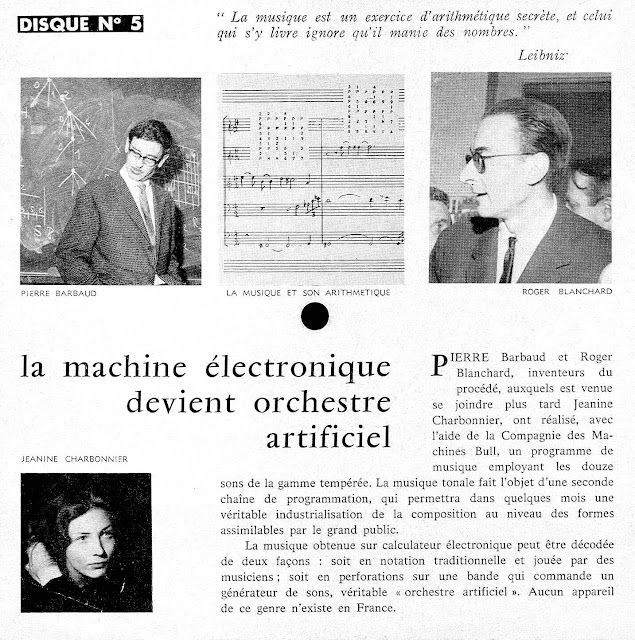
Elève d'Alexandre Tcherepnine, Pierre Barbaud (1911-1990) poursuit jusqu'en 1958 une carrière de compositeur "classique". Au début des années 60, il est le premier en France après Lejaren Hiller aux Etats-Unis, à utiliser l'ordinateur pour la composition musicale, avec des oeuvres comme "Factorielle 7" (1960) ou "Saturnia Tellus" (1980).


Après s'être fait une place de 1959 à 1975, dans les locaux de la Compagnie des Machines Bull, qui devient Bull General Electric en 1964, il est admis à titre gratuit à utiliser le calculateur disponible au siège de la société. Il se situe, à cette époque, au cœur d'une rivalité étrangère dans le monde artistique qui deviendra révélatrice d'une certaine politique de l'art en France à cette époque: en 1961-1962, Iannis Xenakis achète en effet du temps de calcul à la compagnie IBM pour réaliser la série des œuvres ST/48, ST/10 et ST/4. Cette rivalité se déplacera ensuite sur le terrain médiatique, mais Pierre Barbaud entretiendra toujours avec le compositeur d'origine grecque des relations courtoises.

Avec l'aide de Roger Blanchard et de Jeanine Charbonnier, il est donc à l'origine du  procédé de "Musique Algorithmique" autour de 1960.

http://ehess.modelisationsavoirs.fr/seminaire/seminaire11-12/04-25jan12-MB+PB/sonorama/sonorama.html


Les difficultés financières de la CII Honeywell Bull auront raison de cette participation et le compositeur deviendra alors chef de projet  à l'Institut de Recherche en Informatique et Automatique (IRIA devenu INRIA en 1979), sorte d'écho au GMAP (Groupe de Musique Algorithmique de Paris) au sein duquel il travailla dans les années 60.


Ici "Terra ignote ubi sunt leo" composition sur bande, avec un titre en latin, 
composée en 1975 pendant les dernières années de sa carrière, 
communément appelées les "années INRIA"


Pierre Barbaud compose également de nombreuses musiques de film, et notamment en 1957 celle du documentaire "Le mystère de l'atelier 15", filmé par Alain Resnais et co-réalisé avec André Heinrich. Ce film traite des maladies professionnelles, il est tourné à l'usine Francolor de Oissel en Seine-Maritime sous forme d'une enquête scientifique pour découvrir l'origine d'un mal mystérieux dont est atteint un ouvrier d'un atelier de l'usine.
La vision cauchemardesque et hallucinée de l'usine, ainsi qu'une construction narrative pleine de suspense font de ce court-métrage un chef d’œuvre du genre.

 
!!!!

30/06/2017

Manhatta


"Manhatta" is a short documentary directed in 1921 by the famous photographer Paul Strand and the painter Charles Sheeler, including excerpts from the writings of Walt Whitman. 


The movie consists of 65 shots sequenced in a loose non-narrative structure around the city of Manhattan. Completely restored in January 2009 by archivist Bruce Posner, a musical score was added with a music by Donald Sosin, one of today’s leading silent film composers. 

29/06/2017

Elisabeth Chojnacka


RIP Elisabeth Chojnacka, one of the best harpsichord player in the last decennies, 
so famous for contemporary music...

She loved to play Maurice Ohana (Wamba et Conga - 1983), Henryk Górecki (Concerto pour clavecin - 1980), Toshi Ichiyanagi, Franco Donatoni, Marius Constant, Francis Poulenc, Luc Ferrari, André Boucourechliev, Francis Miroglio, Aldo Clementi, Roberto Carnevale, Betsy Jolas, Manuel de Falla, Jean Wiener, Krzysztof Meyer 
as well lot of contemporary legends just composed for her harpsichord' pieces: György Ligeti, François-Bernard Mâche, Iannis Xenakis, Zygmunt Krauze and Michael Nyman.


"Wamba et Conga" - Maurice Ohana - played by Elisabeth Chojnacka,
Recorded in October 1987 in Studio 107, Maison de Radio France, Paris


https://www.discogs.com/fr/artist/212000-Elisabeth-Chojnacka

"Hungarian Rock" (Chaconne) - György Ligeti by Elisabeth Chojnacka


"Insertions" (de Francis Miroglio) fait aussi appel à la forme ouverte comme Archipel Vb (1970) et Anarchipel (1971) d’André Boucourechliev, ainsi que Musical Box (1970) de Georges Aperghis. ... "Insertions" se compose de huit séquences dont l’enchaînement est libre, et dont la dernière fait appel à l’imagination et à la créativité de l’interprète qui la construit à l’aide de motifs désignés par le compositeur dans les séquences précédentes..." 
Emmanuelle Tat - Le Clavecin en France

https://www.discogs.com/fr/Elisabeth-Chojnacka-Clavecin-2-000-Harpsichord-Cembalo-2-000/master/1027400

"Insertions" composed by Francis Miroglio

28/06/2017

Why are we sleeping?


"Why are we sleeping?"
the well known song from the debut album of Soft Machine (1968), when Kevin Ayers was its bass player.
Here, later in 1970, live at the Tavern with the young Mike Oldfield and the great Lol Coxhill on saxophone...

20/06/2017

Poetry of the telephone

http://www.bbc.co.uk/programmes/b08v8lzk

Our friend, the english artist Graeme Miller captures the poetry of the landline. In this half hour, we follow the arc of a single call from dialling to hanging up, taking in the sweep across the global landscape of the 20th century. He draws out the private habits and distinctive speech as well as the collective dreams and nightmares of the landlines art and culture.


"Brighstone 428" is a wonderfull radio-show on BBC Radio 3, a sound-drama treating of the poetry of this emotive way to communicate with people (in the 70s: at home, or standing inside a cabin, or out in the traffic' tumult) and the nostalgia of theses old fashioned rings.

"While collaging the mores and cadences of telephone behaviour and speech the piece also lands in the physical space of the landline - the actual line and the real land. The world of the telephone engineer atop a telegraph pole; the village operator, the maintenance or laying of underwater cables, the middle-of-nowhere phonebox which exists oblique to the density of traffic of information and chat.
The plot lines of death and murder stalking the crossed lines of the city, to the call of the worried voice "Are you still there?". All these spaces are opened up with the reassurances and communities of landline use."
extract of the presentation on the BBC3 post

just click here  
and enjoy!


Also highly recommended: this Radio Nova's jingle from the early 80, using some famous "human voice"...

16/06/2017

Grooves (3) - Scott Macleod


Scott Macleod is living in Oakland (California).
Writer and artist, he has made live, time-based, media, conceptual and/or static work 
in the USA and internationally since 1979. 
His installations and paintings have exhibited in the USA
 and in the Czech Republic, Belgium, England, Italy and Germany. 

Beside of a large-scale production, he produced a serie of targets 
which are wall-mounted sculptures made by unwinding rolled-paper dartboards 
& then rewinding them in various configurations. 


an exhibition "Cibles - Targets",
with some Macleod' pieces,
is now located for this summer in Barjols (France)
curated by Christiane Ainsley & Thierry Azam  &  "Artmandat"


09/06/2017

Mariachi inouïe

 
pic credit: Benjamin Viot

Mariachi is the Nina Garcia's solo project: a radical process around her solid body guitar.
Using the entirety of the instrument as a large palette of sounds as squeaks, roars, rustlings, scrapings, harmonics, metallic impacts, feedbacks, with sometime one or two emerging simple notes and tuned chords, Mariachi make us do an amazing acid-electric-noisy trip.


On the Parisian non-label "No Lagos", her CD compiles different pieces recorded during live performances.

"… un long et tranchant morceau montagneux qui s’enfonce dans le crâne comme l’écho du mauvais temps qui se répercute en montagne. Je ne sais pas à quoi ça tient, peut être la simplicité de l’agencement des sons, la simplicité brutale et décidée des manipulations sur scène, mais il y a quelque chose de très physique dans ce son, quelque chose de tout en muscles et en tension... " - no lagos musique zine, n°1, mars 2015

She sometimes uses to play in duo with the trombone player Maria Bertel: >>>here<<<
and also in trio and quartet with other people.

live at Lausanne Underground Film & Music Festival in Lausanne 20.10.2016

01/06/2017

Grooves (2)

Jean-Pierre Bourquin - "sans titre" tiré de la série "emballages"


Jean Pierre Bourquin - sans titre

_________________________________________________________

unknown sources


_________________________________________________________

"Etude geste", a work by Marie Reinert